
Spine Care (MIRSS)
India's most advanced robotic spine surgery institute — 1,500+ robotic spine surgeries performed

Overview
The Manipal Institute of Robotic Spine Surgery (MIRSS) offers advanced and precise spine care designed for international patients seeking world-class treatment. Using cutting-edge robotic technology and minimally invasive techniques, MIRSS treats a wide range of spine disorders with exceptional accuracy and safety. With highly trained specialists, modern infrastructure, and comprehensive support services, Manipal Hospitals is considered one of the best hospitals for spine surgery and a top destination for global patients. For many, India stands among the best countries for spine surgery due to its blend of expertise, affordability, and outcomes. Many patients from Mauritius have already been successfully treated at MIRSS — and you can contact our Manipal representative for Mauritius directly, with no agent needed.
What is Spine Care (MIRSS)?
Spine care at MIRSS focuses on diagnosing and treating conditions related to the backbone—its bones, discs, nerves, and supporting structures. The spine acts like the body's main pillar, and when it becomes weak, misaligned, or compressed, it can cause pain or mobility issues. Treatments address conditions such as disc problems, nerve compression, deformities, fractures, and age-related spine changes.
Why is Robotic Spine Care Needed?
- Degenerative Disc Disease: Progressive wear of spinal discs causing pain and reduced flexibility.
- Herniated Disc: Disc material pressing on nerves, causing back or leg pain.
- Spinal Stenosis: Narrowing of the spinal canal leading to nerve compression.
- Spine Deformities: Conditions like scoliosis or kyphosis affecting posture and movement.
- Spinal Fractures: Often caused by trauma or osteoporosis.
- Tumours or Infections: Serious conditions requiring reconstructive or corrective surgery.
Why Choose Manipal Hospitals for Spine Care (MIRSS)?
Manipal Hospitals is the first and only corporate hospital in India to bring together three leading technologies in one operating room: the second-generation Mazor X robotic guidance system, the intraoperative 3D O-arm imaging system, and the Allen Advance surgical table. With more than 1,500 successful robotic spine surgeries, MIRSS is recognised for its high surgical volumes, multidisciplinary expertise, and minimally invasive approach. International patients benefit from personalised care pathways, specialised coordinators, transparent communication, rehabilitation support, and seamless pre- and post-operative planning. These strengths position Manipal Hospitals as one of the best hospitals for spine and a leading choice for complex spinal conditions worldwide.
Meet Our Lead Spine Surgeon
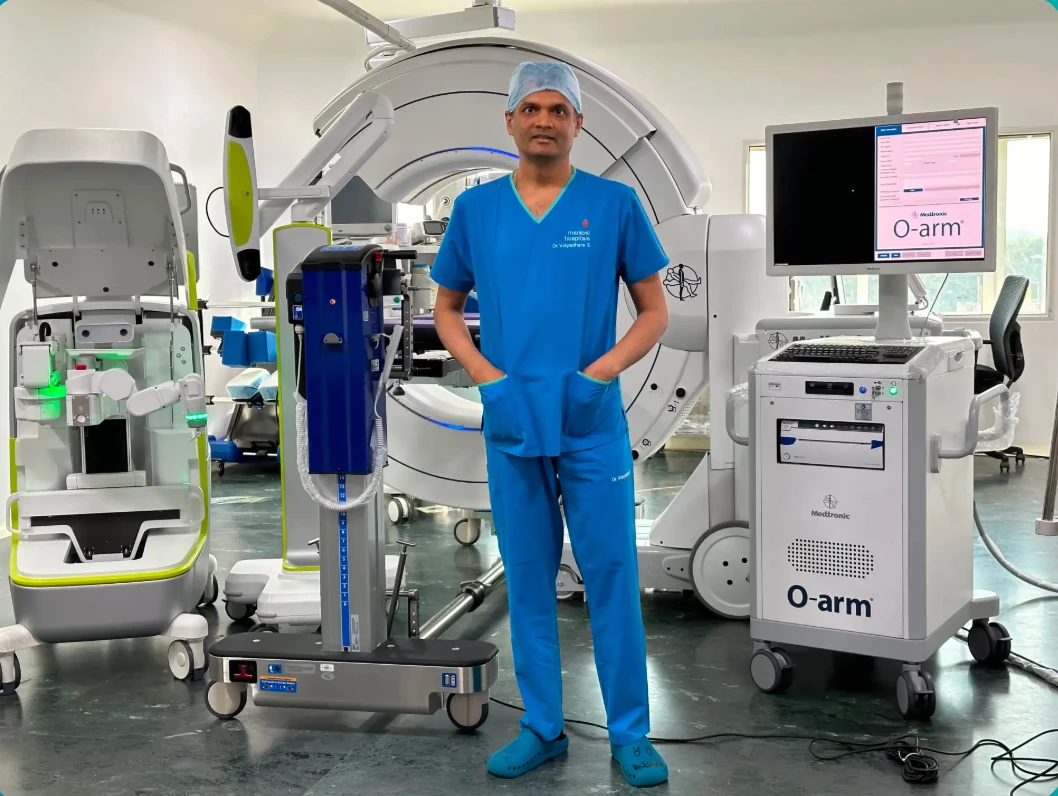
Dr. S. Vidyadhara
Chairman & Consultant – Spine Surgery, Manipal Hospitals Old Airport Road, Bangalore
Dr. Vidyadhara is the founder of the Manipal Comprehensive Spine Care Center and the Manipal Institute of Robotic Spine Surgery (MIRSS). With more than 20,000 spine surgeries and over 1,000 robotic procedures to his name, he is one of India's most experienced robotic spine surgeons. He has received more than 30 awards and fellowships, including the SRS Traveling Fellowship (USA), and has trained over 30 spine surgeons.
A Complete Spine Team Around You
Every patient is cared for by a dedicated team of spine surgeons, spine anaesthesiologists, spine physiotherapists, neuropsychologists and radiologists.
Types of Procedures Offered
- Robotic-Assisted Spinal Fusion: A precision-driven procedure that stabilises the spine by joining two or more vertebrae, performed using robotic technology to enhance alignment and reduce risks.
- Minimally Invasive Spinal Stabilization: Performed through small incisions to stabilise weak or unstable segments, this method reduces tissue damage, postoperative pain, and recovery time.
- Discectomy (Microlumbar / Endoscopic): A procedure to remove the portion of a herniated disc that is pressing on nerves, performed through minimally invasive or endoscopic approaches.
- Artificial Disc Replacement: A motion-preserving surgery that replaces a damaged spinal disc with an artificial one to restore natural movement and reduce pain.
- Vertebroplasty / Kyphoplasty: Techniques used to treat vertebral compression fractures by injecting bone cement or using a balloon system to restore height and relieve pain.
- Spinal Osteotomies & Reconstruction: Complex corrective surgeries for severe deformities such as scoliosis or kyphosis, aimed at restoring alignment and mobility.
Who is the Right Candidate for Spine (MIRSS) Treatment?
- Persistent back or neck pain despite conservative therapy
- Spine instability or structural deformity
- Nerve compression symptoms like numbness or radiating pain
- Fractures or spine collapse due to trauma or osteoporosis
- International patients seeking advanced, precise surgical care
Who Should Avoid or Delay Spine Treatment?
- Patients with uncontrolled chronic illnesses
- Active infections anywhere in the body
- Individuals unable to undergo anaesthesia safely
- Those who cannot commit to rehabilitation or follow-up
- Patients with incomplete travel or medical arrangements
Preparing for Spine Surgery at MIRSS
- Complete essential tests: MRI, CT scan, blood work, and neurological evaluation
- Review medical history, medications, and previous treatments
- Adopt healthy changes: stop smoking, maintain nutrition, manage weight
- Plan travel, visas, documentation, and a caregiver
- Understand rehabilitation requirements for post-surgery recovery
What Happens During the Procedure?
The patient is prepared and placed under anaesthesia. Robotic systems help design a precise surgical plan, enhancing accuracy. Surgeons make small incisions to place screws, implants, or perform decompression. Advanced nerve monitoring (MEP, SSEP and EMG) protects the spinal cord and nerves throughout the operation for maximum safety. After closure, patients are shifted to recovery and monitored before discharge.
Recovery After Spine Surgery
Recovery varies by procedure, but with robotic minimally invasive surgery many patients are walking within hours and go home the very next day. Early movement is encouraged with guided physiotherapy. International patients receive a customized rehabilitation plan, along with virtual follow-up support. Long-term improvement includes pain relief, increased stability, and better mobility over weeks to months.
Real Stories from Mauritian Patients
Mr. Patrick Berthier, Mauritius
After four previous back surgeries elsewhere brought little relief, Patrick came to Manipal Hospitals. Dr. S. Vidyadhara performed a robotic-assisted decompression and fusion. Patrick was up and walking within six hours, went home the next day, and one week later was almost completely pain-free and fit to fly back to Mauritius.
Mr. Kushal Singh Mondal, Mauritius
Kushal lived with severe lower back pain spreading to his legs for more than four years. After a robotic-assisted minimally invasive fusion by Dr. S. Vidyadhara, he was walking within hours of surgery, discharged the next day, and made an excellent recovery.
Risks & Complications
Possible risks include infection, blood loss, or temporary nerve irritation. More serious complications—like dural tears or hardware issues—occur less frequently. Robotic precision, modern imaging, and expert surgical teams help reduce these risks significantly, ensuring a safer surgical experience.
Benefits of Spine (MIRSS) Treatment
Patients benefit from increased precision, reduced surgical trauma, shorter recovery, and improved long-term outcomes. Robotic and minimally invasive methods enhance accuracy, decrease pain, and promote quicker mobility. The approach is highly effective for restoring quality of life and reducing chronic spine-related limitations.
Cost of Spine Surgery at Manipal Hospitals
Costs vary depending on the type of procedure, technology used, and length of hospital stay. Compared to many Western countries, India offers high-quality spine surgery at significantly more affordable rates. This value makes India one of the best countries for spine surgery, especially for international patients.
Recognised Worldwide
In 2024, MIRSS hosted Manipal Spine Roboticon, an international conference featuring 10 live robotic spine surgeries. More than 350 spine, neuro and orthopaedic surgeons from 22 countries came to learn from the MIRSS team.
Why International Patients Trust Manipal Hospitals
Manipal Hospitals has decades of expertise, high surgical success rates, and world-class technology. Thousands of global patients choose MIRSS for its precision, safety, and ethical medical practices. The presence of dedicated international patient services ensures smooth coordination, timely communication, and consistent support before and after treatment.
Speak Directly to Manipal Hospitals — From Mauritius
Send us your reports and get a free opinion from our spine specialists. Damian Androse, Manipal's representative for Mauritian patients, will guide you personally through every step — medical opinion, travel, stay and follow-up. No agent needed.